The Economics
of Deception
Sum-of-Parts
Arbitrage
In the upper reaches of the vintage horology market, outright counterfeiting has yielded to a more insidious and profitable discipline: sum-of-parts arbitrage. For collectors mastery of this phenomenon is no longer optional. Super-Franken watches—industrialised composites that marry high-fidelity cloned chassis with authentic OEM components—exploit the extreme financial premia attached to specific aesthetic signatures. They represent the apex of deception in a market where cultural reverence for originality has been monetised to its limit. Understanding this dynamic illuminates how sociological shifts toward purist absolutism create both vulnerability and opportunity in secondary-market pricing.
The Economics of Component Arbitrage
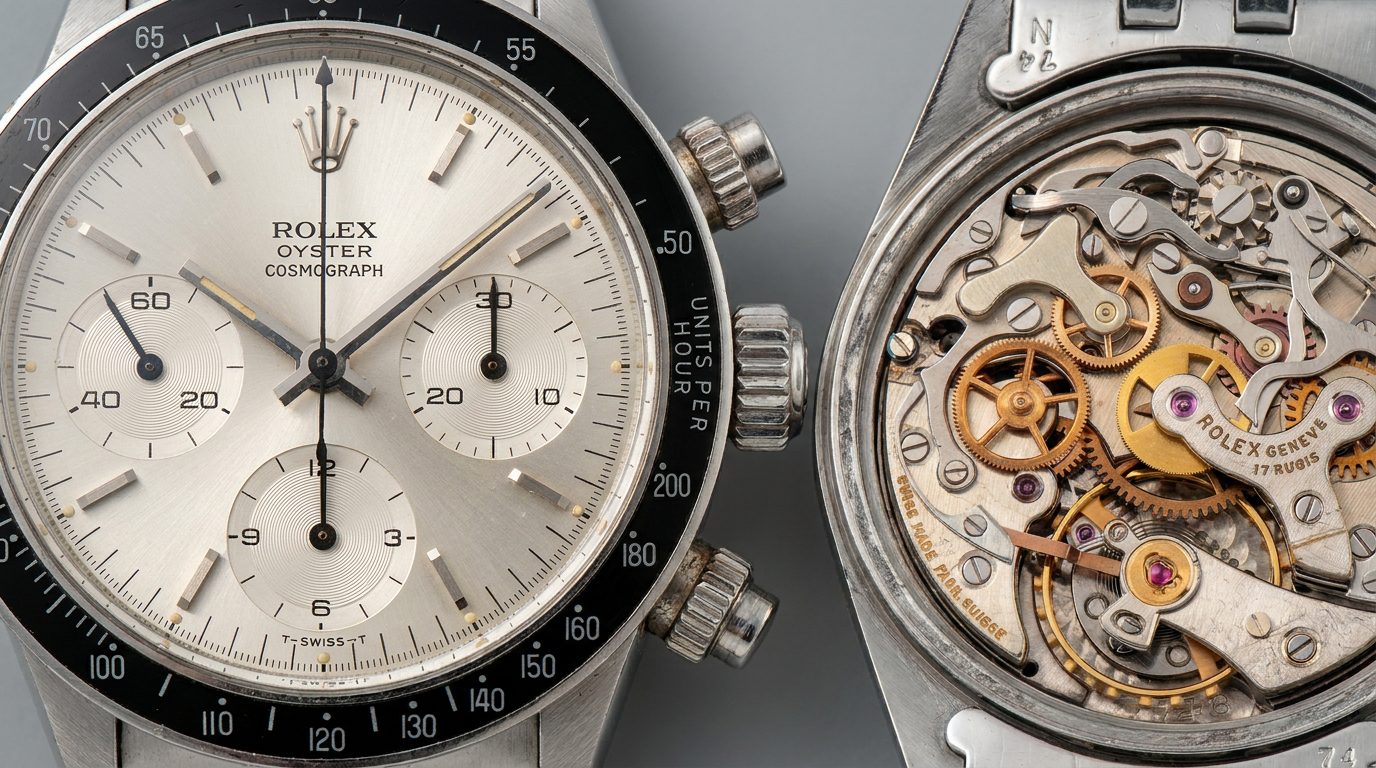
The structural incentive for such arbitrage lies in the commodification of minutiae. In investment-grade references, marginal differences—typographic subtleties on a dial, the precise patina of a bezel insert—account for the overwhelming share of terminal value, even when the underlying mechanical architecture remains identical. Consider the early 1970s Rolex Daytona: a standard manual-wound example with Valjoux movement trades in the $40,000–$50,000 range on the secondary market. Fit the same case and movement with a genuine Paul Newman “Exotic” dial, and valuation leaps to $150,000–$175,000.
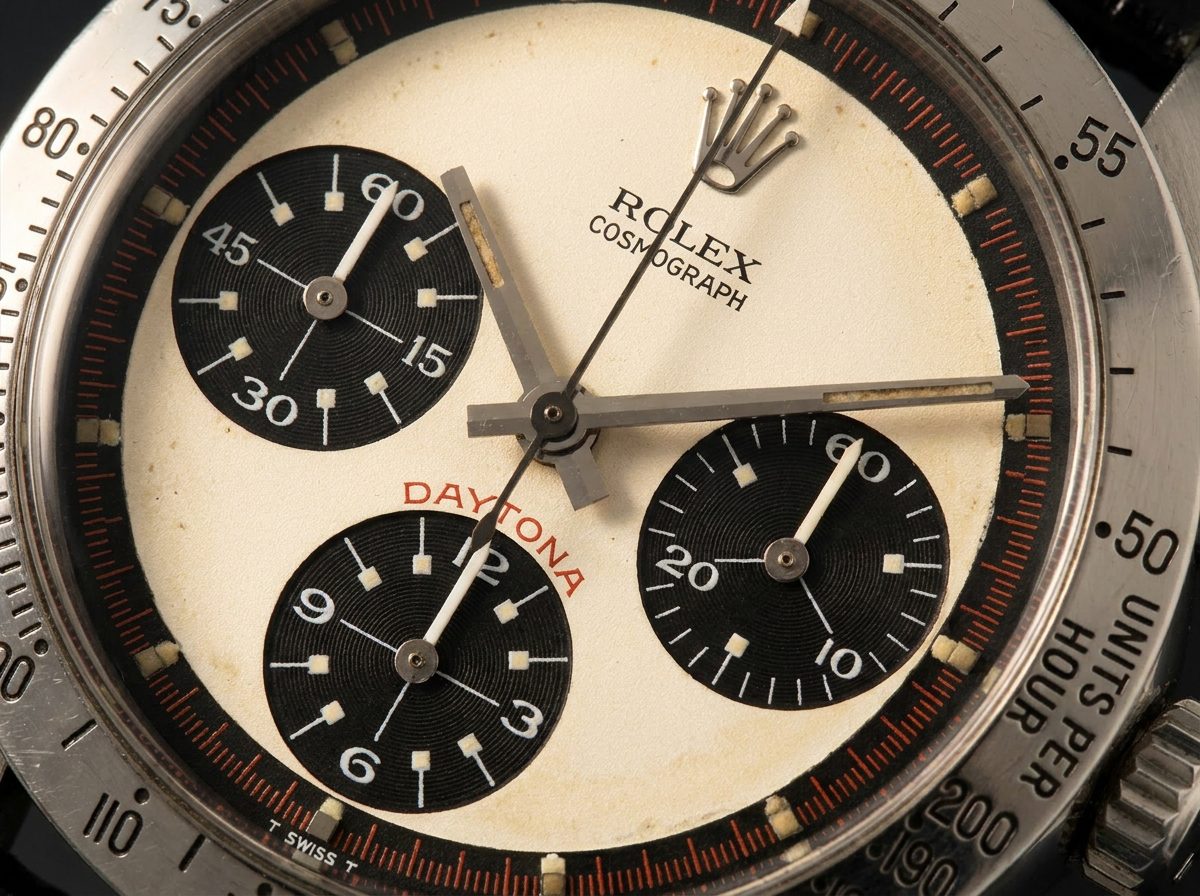
Here, up to 90 percent of the asset’s equity resides in a few square centimetres of printed surface. This concentration of value transforms components into high-yield instruments for arbitrage.
What began as opportunistic dealer “dial swapping” has scaled into systematic production.

Veteran Tom Bolt recalls the earlier era with characteristic candour: “If you had two watches… one with a lovely case but the face a little past its sell-by date, and the other with a lovely face but a polished case, you could end up with one really beautiful watch.” Today, illicit networks purchase geometrically precise “Super Clone” bases—often from operators such as Clean Factory or VS Factory—for $500–$800. They source authenticated vintage dials and bezel inserts on the grey parts market for approximately $3,000. Total build cost hovers around $3,500.
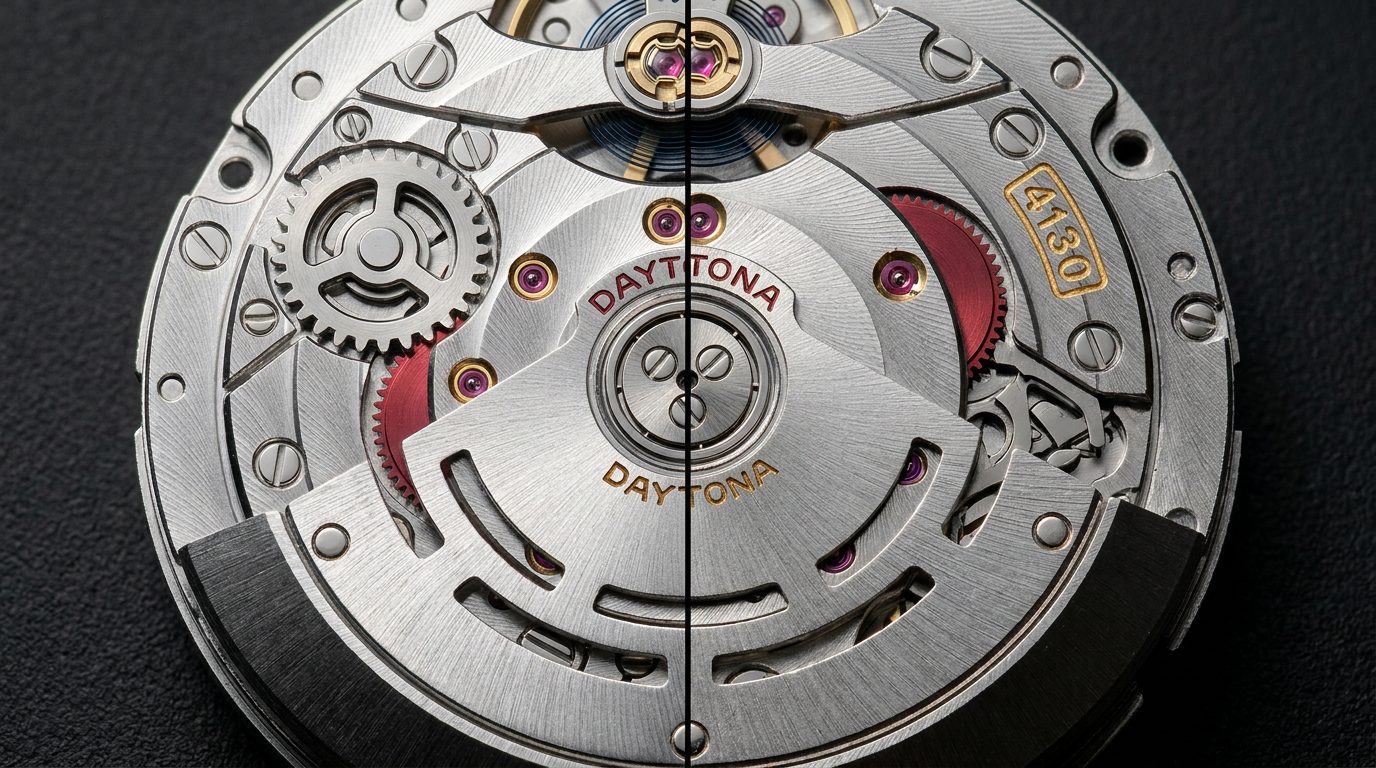
The completed composite enters the grey market as ostensibly factory-original, realising $12,000–$14,000. The margin—nearly $10,000 per unit—illustrates pure information asymmetry profit, detached from any contribution to genuine scarcity or craftsmanship.
This economic reality reflects a deeper cultural transition. As mechanical watches evolved from instruments of utility into Veblen assets signalling status and connoisseurship, the market began pricing narrative authenticity above mechanical integrity. The dial, once a functional interface, became the primary carrier of provenance mythology. That redefinition created the very arbitrage window now exploited at industrial scale.
The Psychological Exploit: The “Halo Effect”
Success of the Super-Franken rests on a predictable behavioural bias: the halo effect, or anchoring exploit. Upon inspection, the authenticator’s gaze is captured by the most salient visual cues—the crisp dial texture, the undisturbed lume plots, the genuine precious-metal bezel. These OEM elements project empirical legitimacy so powerfully that they extend a halo of trust across the entire assembly. Subtle dimensional discrepancies in the cloned mid-case or the reverse-engineered Dandong movement hidden beneath remain psychologically invisible. As Bolt has observed across decades of trade, “complications are sometimes used as makeup to hide the blemishes.” In the Super-Franken, the authentic dial functions precisely as that cosmetic veil.
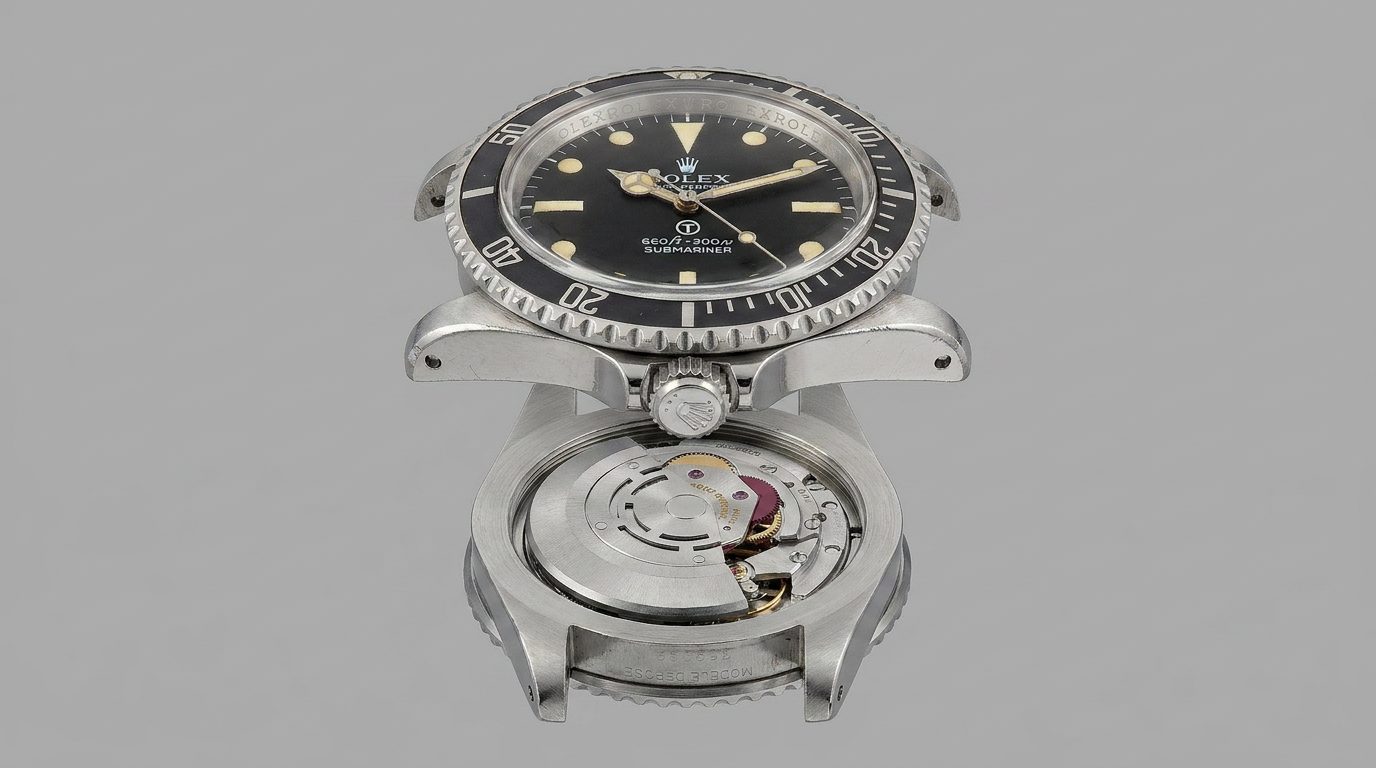
This cognitive vulnerability is amplified by the market’s own success. Having trained participants to revere specific aesthetic configurations as proxies for rarity, the industry inadvertently equipped fraudsters with the perfect psychological lever. The halo effect does not merely deceive individuals; it temporarily distorts collective price discovery, allowing compromised assets to trade at unadjusted premia until forensic scrutiny intervenes.
Few examples illustrate the brutality of exposure more clearly than the Rolex “Albino” Daytona Reference 6263. In the late 1990s, Bolt himself transplanted an all-silver service dial—originally intended for an earlier Ref. 6238 Pre-Daytona—into a standard 6263 case. The resulting hybrid acquired mythical status, culminating in a 2015 Phillips Geneva sale where an example with Eric Clapton provenance achieved 1.3 million Swiss Francs.
Digital forensics delivered the reckoning. In December 2025, independent researchers including Perezcope conclusively demonstrated the dial’s period-incongruent origins as 1990s service stock. Market confidence evaporated. A comparable Albino offered at Sotheby’s Abu Dhabi, despite a private transaction history near $3 million, realised only $750,000 hammer price ($952,500 with premium)—a 75 percent destruction of value driven solely by public revelation of its constructed nature. The episode serves as a cautionary archetype: provenance narratives built on sum-of-parts logic may sustain inflated valuations for years, yet collapse instantaneously when cultural consensus shifts from acceptance to condemnation.
Strategic Imperative for Investors
The Super-Franken phenomenon demands a fundamental recalibration of acquisition discipline. Superficial visual or documentary authentication no longer suffices to protect capital. Institutional-grade protocols are now table stakes: unbroken provenance chains stretching to original retail, forensic imaging, X-ray fluorescence (XRF) for material composition, and micro-CT scanning to verify internal construction. These measures pierce the halo effect and re-anchor valuation in verifiable history rather than projected aesthetics.
Cultural baselines around authenticity are not static; they harden as markets mature and information diffuses. Each tightening of standards raises the price floor for genuinely original specimens while imposing steeper discounts—or outright illiquidity—on composites. Those who internalise sum-of-parts arbitrage as both risk vector and cultural signal gain asymmetric advantage. They avoid the minefield, concentrate on watches whose stories remain impregnable, and capture the most resilient premia in the horological asset class.
In an age of monetary abstraction, the enduring watches are those whose integrity transcends component arithmetic. Their value derives not from the sum of parts, but from the unbroken cultural and forensic narrative those parts collectively affirm.
The Documentation
Premium
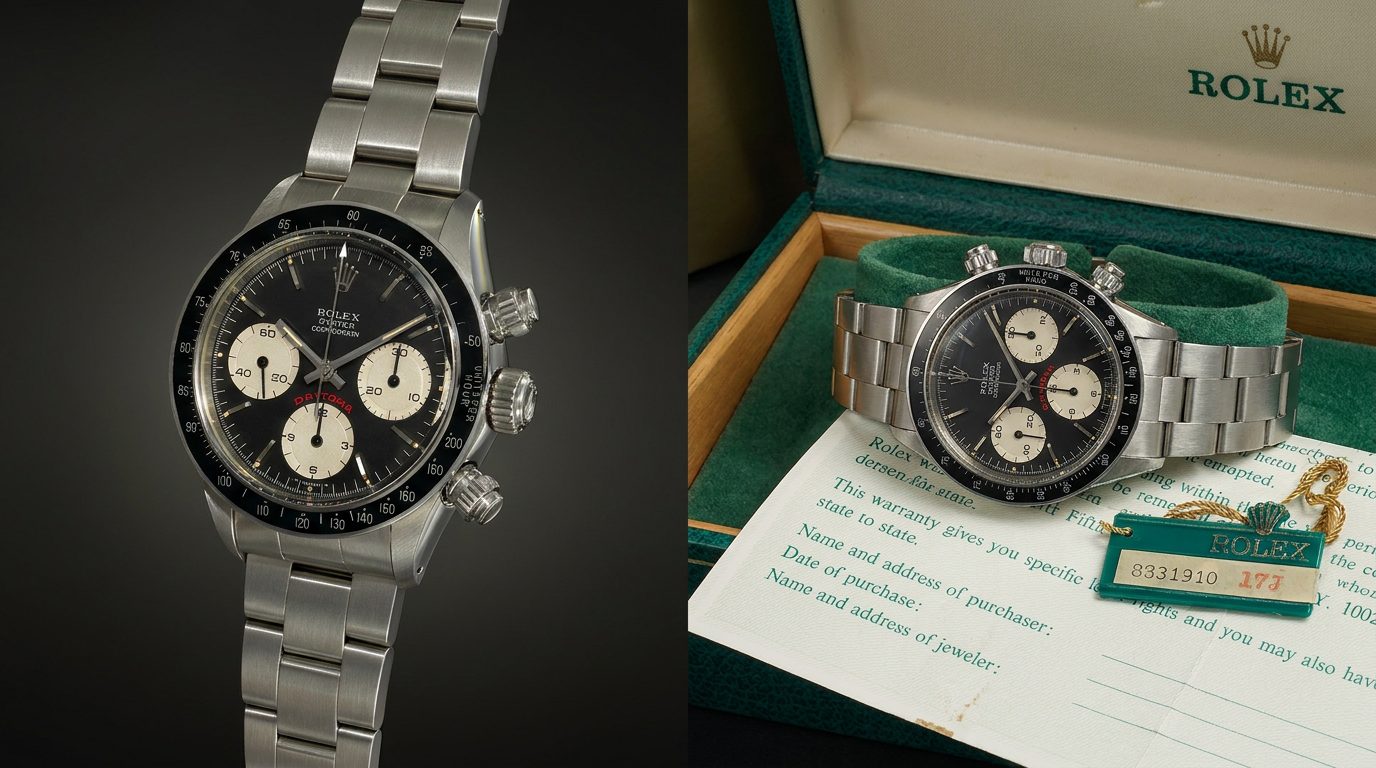
In the fully financialised landscape of vintage horology, the physical timepiece has been eclipsed by its documentary shadow. Original “Box and Papers” now function as de facto title, collateral, and liquidity multiplier. This cultural elevation of printed ephemera above the artefact itself has created one of the market’s most pronounced asymmetries: a premium for documentation that frequently exceeds the incremental value of mechanical refinement. Yet this reliance has also spawned a sophisticated ecosystem of identity theft, transforming the very instruments designed to guarantee provenance into vectors for high-yield fraud.
The Economics of the “Paper Premium”
Market data consistently demonstrates the documentation premium’s magnitude. A complete “Full Set” routinely commands 20 to 40 percent above an otherwise identical reference sold watch-only, even when mechanical condition, case wear, and dial patina are indistinguishable. Liquidity follows suit: full sets close 13 percent faster on average, reflecting reduced buyer hesitation in an environment saturated with composites and clones. Conversely, the absence of papers can compress insurance valuations by more than 30 percent, crystallising the market’s collective pricing of uncertainty.
This premium is not rooted in legal enforceability—retail packaging and warranty cards confer no enduring title—but in a crisis of confidence. As Super-Franken assemblies and period-incongruent Frankenwatches proliferate beyond the diagnostic reach of most dealers, participants have outsourced authenticity to branded cardboard and ink. Tom Bolt, observing the evolution across three decades, recalls an earlier pragmatism when boxes were regarded as mere packaging. Today’s exponential premia, he argues, arise “because most watch dealers haven’t got a clue what they meant to be looking for.” In an age of mechanical democratisation, cultural capital has migrated from the movement to the narrative wrapper. That redefinition has hardened a durable price floor for documented assets while imposing steep discounts on undocumented equivalents.
Industrial Forgery and the “Papergate” Paradigm
The financial incentive—tens of thousands of dollars of instant equity from a few sheets of paper—inevitably birthed an industrial forgery sector. The 2015 “Papergate” scandal laid bare its sophistication. Syndicates acquired vast stocks of blank “New Old Stock” warranty papers and reverse-engineered the original mechanical perforation tools used by Rolex distributors from the 1960s to 1980s. Employing high-carbon steel rods and custom staking apparatus, they replicated the precise dot-matrix spacing and hole diameters of factory punch machines. To evade ultraviolet and chemical analysis, specialist laboratories recreated iron-gall ink formulations, matching the acidic, corrosive bite characteristic of mid-century certificates.
With these tools, loose “naked” watches were rapidly converted into premium full sets. The operation scaled efficiently: authentic but orphaned paperwork met compliant but unpapered movements and cases, producing assets that satisfied superficial market expectations. The episode revealed a deeper cultural irony. As collectors fetishised provenance documentation as proxy for untouched originality, they inadvertently incentivised the precise forgery of that documentation—elevating paper from curatorial accessory to primary fraud instrument.
The “Papergate” Scandal — Printing Equity
In the contemporary vintage market, original documentation—colloquially known as “box and papers”—has evolved from a curatorial afterthought into a primary driver of asset valuation. Our resident expert Tom Bolt reflects on this unnatural elevation, noting, “...when I first started dealing in watches, ‘box and docs’ were nice, but it wasn’t the be-all and end-all, right? It was just a cardboard box and paper. But the reason why papers and boxes have had such premiums and values added to them in the last 7 to 10 years is because most watch dealers haven’t got a clue what they are meant to be looking for.” This collective outsourcing of authentication to printed ephemera created a massive financial asymmetry: a 20% to 40% valuation premium simply for possessing the original paperwork. Inevitably, this massive margin birthed an industrial forgery sector, culminating in the 2015 “Papergate” scandal.
The mechanics of the Papergate fraud relied on a devastating combination of authentic materials and highly sophisticated mechanical replication. Organized syndicates realized they could instantly capture tens of thousands of dollars in “Full Set” equity by fabricating warranty papers for loose, “naked” timepieces. To bypass standard forensic countermeasures, counterfeiters acquired vast quantities of “New Old Stock” (NOS) blank vintage warranty certificates from the black market. Because these unissued documents were genuinely manufactured by Swiss suppliers decades prior, they inherently passed all chemical and ultraviolet (UV) paper analyses, leaving the mechanical perforation of the watch’s serial number as the sole hurdle to a perfect forgery.
To execute the illusion, forensic analysts discovered that these syndicates had successfully reverse-engineered the precise mechanical punch apparatuses used by Rolex distributors in the 1970s and 1980s. Utilizing specialized horological staking tools, illicit engineers turned and milled high-carbon steel rods to match the exact microscopic shape, hole diameter, and serif font structures of proprietary Rolex perforation dies. The sophistication of the operation was absolute; forgers even successfully replicated subtle regional anomalies, meticulously distinguishing between the English 4x5 punch pattern and the European 4x6 pattern. By punching the serial numbers of naked watches into genuine blank stock, these operations mass-produced undetectable forgeries overnight, effectively laundering compromised, stolen, or incomplete assets into premium “grail” investments.
The exposure of Papergate deeply rattled collector confidence, proving that the market’s reliance on physical documentation was a systemic vulnerability rather than a definitive safeguard. The revelation that criminal syndicates were effectively “printing equity” forced the Swiss establishment to fundamentally rethink its certification architecture. Recognizing that physical paper could no longer guarantee provenance against industrial-scale reverse engineering, Rolex executed a major defensive maneuver in late 2020, abandoning traditional paper and plastic warranty cards entirely in favor of embedded Near-Field Communication (NFC) chips. The scandal serves as a stark, permanent warning to the Tier-1 allocator: when a market prizes the documentary wrapper above the physical artifact, it inevitably incentivizes the flawless forgery of the wrapper.
Horological Identity Theft: The “Case Recut”
When high-value paperwork exists without a matching watch, the physical asset is reshaped to fit the document. Advanced metallurgical manipulation—known as “case recut”—employs 1064 nm fibre lasers to ablate original serial and reference numbers between the lugs. Sophisticated CNC laser-etching systems then imprint new identifiers precisely calibrated to the orphaned papers. The result is a seamless marriage of authentic documentation and surgically altered case, engineered to survive standard visual and basic forensic inspection.
Bolt draws an unambiguous ethical and commercial boundary here. While component swaps invite debate, deliberate renumbering constitutes outright identity theft. “If you find some spare papers, people will actually have an original watch renumbered to match those papers because that is going to increase its value,” he notes. “For me, however, if a watch has been renumbered… that is a fake. When you purposefully and knowingly alter the registration of a watch’s number, that is a fake watch.” His stance underscores a critical market truth: tampering with the watch’s singular registration number severs its verifiable link to history, converting a genuine artefact into a constructed fiction regardless of component authenticity.
The Psychological Exploit and Market Dynamics
The efficacy of these schemes rests on the halo effect. When a modified or recut watch is presented alongside period-correct, apparently pristine manufacturer paperwork, the documentation projects legitimacy across the entire assembly. Bidders and even seasoned authenticators subconsciously extend trust from the papers to the object, anchoring valuation at full-set levels. This cognitive bias has sustained inflated hammer prices until forensic scrutiny—serial database cross-referencing, laser ablation signatures, or metallurgical mismatch—intervenes.
The phenomenon illustrates behavioural economics in real time: heightened fear of deception drives over-reliance on easily forged signals, widening the valuation gap between verifiably pristine assets and those resting on documentary illusion. Cultural demand for narrative completeness has thus created its own vulnerability.
Strategic Imperative for Investors
For serious capital deployment in vintage horology, the documentation premium demands recalibration rather than rejection. Box and papers retain legitimate value as historical context and market lubricant, yet they must never substitute for unbroken chains of custody or forensic validation. Institutional due diligence now requires metallurgical analysis of case engravings, microscopic examination of perforation and ink characteristics, and comprehensive provenance mapping from original retail through subsequent owners.
Allocators who recognise the paper premium as a cultural artefact—rather than a legal or mechanical absolute—gain decisive advantage. They price undocumented but forensically pristine watches more accurately, avoid assets whose identity has been surgically rewritten, and concentrate capital on specimens whose documentation and physical integrity form a single, impregnable narrative.
There is a recurring pattern: as markets mature and cultural baselines harden around authenticity, price floors rise for assets whose provenance withstands every layer of scrutiny. Horological identity theft is not merely fraud; it is a predictable market response to mispriced signals. Those who master the distinction between documentary theatre and verifiable history secure the most resilient valuations anchored not in paper illusions, but in the immutable logic of cultural and forensic truth.